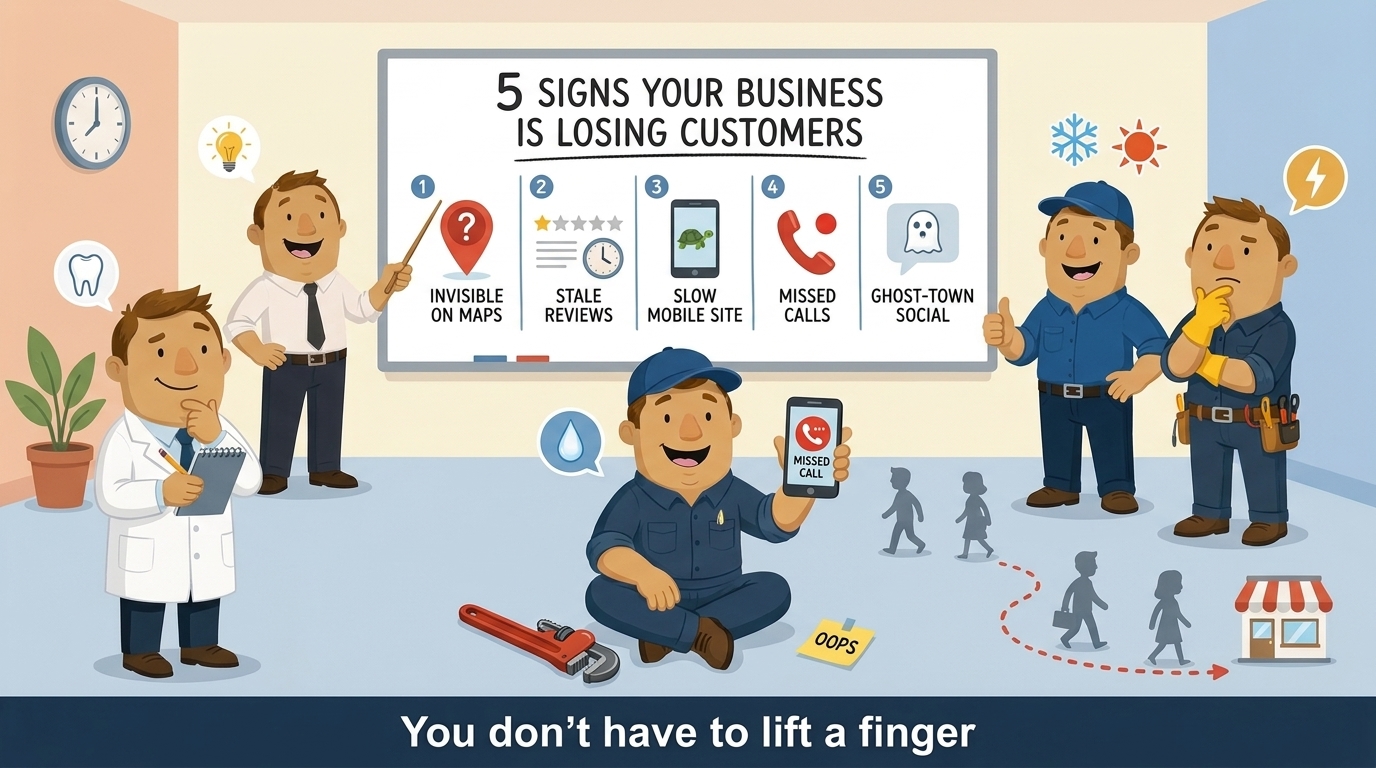
5 Signs Your Local Business Is Losing Customers to Competitors (And Doesn't Know It)
80% of US consumers search online for a local business at least once a week (SOCi Consumer Behavior Index, 2024). Every one of those searches is a quiet audition. Your business either shows up, answers the question, and earns the click, or it doesn't. And when it doesn't, the person doesn't leave you a note. They just call someone else.
That's how most local businesses are losing customers in 2026. Not in one dramatic event. In dozens of small, invisible misses every month.
This post is a diagnosis, not a sales pitch. If any of the five signs below sound familiar, you're probably leaking customers right now. The good news: once you can see the leak, it's fixable.
Key Takeaways
- 46% of all Google searches have local intent — if you're invisible on Maps, you're invisible (HubSpot, 2024)
- 74% of consumers ignore reviews older than 3 months (BrightLocal, 2026)
- A mobile page that takes 3 seconds to load has a 32% higher bounce rate than one that loads in 1 second (Google/SOASTA)
- Home service businesses miss roughly 27% of inbound calls (Invoca, 2024)
- More than half of consumers will switch to a competitor after a single bad experience (Salesforce, 2024)
Why Are Customers Switching to Competitors So Fast?
More than 50% of consumers will switch to a competitor after just one bad experience, and 92% will walk away after two or three (Salesforce State of the Connected Customer, 2024). Customers don't tell you they're leaving. They just try the next name on Google.
That's the part most business owners miss. A "bad experience" in 2026 isn't always a rude employee or a botched job. It's a listing that doesn't answer the question. A voicemail that goes unreturned. A website that pinches to zoom on a phone. Each of these is a quiet exit.
Here are the five signs your local business is creating those exits without realizing it.
Sign 1: Can Anyone Actually Find You on Google Maps?
42% of local searchers click a result from the Google Map Pack — the three businesses that appear at the top with pins and star ratings (Backlinko via BrightLocal, 2024). If your business isn't one of those three, you're sharing the other 58% of clicks with every other business on pages one, two, and beyond.
Most owners check Google by searching their own business name and seeing it pop up. That's not the test. The real test is searching what a customer would type: "plumber near me" or "dentist in [your town]." If you're not in the top three, assume most new customers will never scroll to find you.
The fix isn't a secret. It's a claimed and complete Google Business Profile, real reviews on a regular schedule, accurate hours, and service-area detail. We break down the trade-offs between Maps visibility and paid ads in our Google Ads vs. Google Maps guide for local businesses.
Sign 2: When Did You Last Get a New Review?
74% of consumers only consider reviews from the last three months, and 32% now want reviews from the last two weeks (BrightLocal Local Consumer Review Survey, 2026). A five-star review from 2023 might as well not exist. If your last review was posted six months ago, three out of four customers are discounting your page on sight.
The bar has also moved up. 31% of consumers now say they'll only use a business with a 4.5-star rating or higher, almost double the 17% who said so in 2025 (BrightLocal, 2026). And 32% expect a business to respond to their review within a single day.
What we see in audits: Most local businesses we audit have more than enough happy customers. They just don't have a system that asks for the review at the right moment. A simple post-job text with a direct review link often doubles a business's review count inside 90 days. For a deeper breakdown, see what your competitors' reviews are doing that yours aren't.
Sign 3: Does Your Website Actually Work on a Phone?
More than 60% of global web traffic now comes from mobile devices, and Google has been indexing the mobile version of every site by default since 2023 (Google Search Central). If your site is hard to read, slow to load, or broken on a phone, Google sees the broken version, and so does every potential customer.
Speed matters as much as layout. Google's benchmark research shows that as a mobile page's load time goes from 1 second to 3 seconds, the probability a visitor bounces jumps 32%. At 5 seconds it's 90%. At 10 seconds it's 123% (Think with Google).
Test yours honestly. Open your website on your phone, on mobile data, not Wi-Fi. Can you read it without zooming? Does the click-to-call button work? Does the booking form fit the screen? If any of those answers is no, Google and your customers noticed a long time ago.
Sign 4: Who's Answering When You Can't?
Home service businesses miss roughly 27% of their inbound calls (Invoca Home Services Report, 2024). And callers who reach voicemail often don't bother leaving a message — they just dial the next business on the list.
Think about what that means in practice. For every four people who dial your business today, one is hanging up without reaching anyone. Most of them are not calling twice. They're calling the next plumber, dentist, or HVAC company on the list. That's a direct transfer of revenue to your competitor, and it's happening whether you notice it or not.
The after-hours version of this is worse. A homeowner with a leaking pipe at 10pm or a parent with a toothache on a Sunday isn't waiting until Monday. They're picking the business that answers right now — whether that's a live person, an AI voice receptionist, or a chatbot on your website.
There is no silver bullet here. Some businesses solve it with a 24/7 answering service. Others use AI voice answering paired with website chat. The right answer depends on your call volume and margin. The wrong answer is the one most businesses pick by default: doing nothing and hoping voicemail is enough.
Sign 5: Is Your Social Media a Ghost Town?
Photos matter more than posts for local businesses — the average consumer views around six photos on a Google Business Profile before making a decision, and businesses with regular photo updates see higher engagement (Google Business Profile help / BrightLocal analysis, 2024). An empty Facebook page with a 2021 cover photo and no new photos on your Google profile tells a customer that nobody's minding the store.
This is the least urgent sign on the list, but also the easiest to read. If two plumbers both rank on Maps and both have good reviews, the one with recent photos of real jobs, a handful of happy-customer posts, and responsive messaging will usually win the tie.
You don't need to post every day. You need to post enough that a stranger checking your page in 2026 sees signs of life in the last 30 days.
How to Tell Which Sign Is Making You Lose Customers
You probably have more than one of these signs. That's normal. The question is which one is costing you the most customers right now. Here's a two-minute self-test.
- Open Google in an incognito window and search "[your service] near me." If you're not in the top three map results, Sign 1 is active.
- Check the date of your most recent Google review. If it's older than 60 days, Sign 2 is active.
- Open your website on your phone on mobile data. If it takes more than 3 seconds, is hard to read, or any button is broken, Sign 3 is active.
- Call your main business line from a friend's phone during a busy hour. If it rings more than 4 times or hits voicemail, Sign 4 is active.
- Look at your Facebook or Instagram. If the last post is older than 30 days, Sign 5 is active.
Any sign marked "active" is a line where customers are quietly leaving.
What to Fix First (If You Only Have Time for One Thing)
If you have all five signs, don't try to fix all five. Work in order of impact.
1. Fix the one with the highest customer-value-per-loss. For most service businesses, that's Sign 4 (missed calls). A single missed emergency call can be worth hundreds of dollars of revenue.
2. Fix the visibility problem next. Sign 1 (Google Maps) and Sign 2 (reviews) work together. You can't be chosen if you can't be found, and you can't be found consistently without fresh reviews.
3. Fix the conversion problem third. Sign 3 (mobile website) matters once people are actually landing on your site. If you're invisible, a fast site doesn't help yet.
4. Sign 5 (social media) is last. It's a trust reinforcement, not a lead source for most local businesses. Don't let it eat time that should be going into Signs 1 through 4.
AI marketing tools can automate the mechanics of most of these — review requests after every job, 24/7 chat on your website, social posts that publish themselves. If you're new to what that actually means, our plain-English guide to AI marketing for local business walks through it without jargon.
Want to know which sign is costing you the most? Get a free website and visibility audit and we'll tell you which leak to plug first.
Frequently Asked Questions
How do I know if I'm actually losing customers to competitors?
The quickest check is your weekly phone calls and form fills compared to six months ago. If they've dropped and your business hasn't changed, you're likely being outranked or out-reviewed. 80% of consumers search online for local businesses at least weekly (BrightLocal, 2024), so any visibility drop shows up fast in lead volume. The mechanism: local search is a near-zero-sum game in the map pack — only three businesses appear above the fold, and competitors who rank above you are mathematically intercepting customers who would otherwise have called you. Track call volume, form submissions, and Google Business Profile insights monthly; a 20%+ drop in any of these without a corresponding change in season or local economy is a strong signal you're losing share. The right next step: pull your last six months of GBP insights data and compare "searches" and "website clicks" month-over-month — if the trend is down, you have a visibility problem to fix.
How long does it take to fix these signs?
Most are fixable in 30-90 days. Missed calls (Sign 4) can be solved in a day with AI voice answering or a live answering service. Reviews (Sign 2) typically take 60-90 days to rebuild freshness once a request system is in place. Google Maps ranking (Sign 1) usually moves within 30-60 days of claiming and properly optimising your profile. Website speed (Sign 3) can be improved in a single afternoon with a good host. The mechanism behind the variable timeline: technical fixes (call routing, web hosting) are infrastructure swaps that take effect immediately, while ranking and review signals require Google to observe the new activity pattern over multiple weeks before adjusting your visibility. The right next step: pick the sign with the highest direct revenue impact for your business (usually missed calls or low review velocity) and fix that one first instead of trying to address all five at once.
Do I really need to be on social media?
You don't need to post daily, but an empty page sends the wrong signal. At minimum, keep your profile photo and cover image current, post once or twice a month, and respond to messages within 24 hours. The mechanism: customers researching a local business now treat your social pages as a trust verification step, not a primary discovery channel. According to a 2024 Sprout Social Index, 75% of consumers say a brand's social media presence directly influences their purchase decision, and an abandoned page with three-year-old photos signals "this business may not still be operating" more loudly than no presence at all. Social is the easiest sign to fix and the least urgent of the five, so do it after addressing the first four. The right next step: schedule one hour this month to refresh your profile photo, cover image, hours, and post a single "we're open and here's what we're working on" update.
Which sign costs the most money?
For most local service businesses, Sign 4 (missed calls and messages) has the highest direct revenue impact. Home service businesses miss about 27% of inbound calls (Invoca, 2024). Depending on average job value, that can be thousands of dollars in lost revenue per month from calls that never became customers. The mechanism: every missed call is a customer who has actively decided to spend money and has reached the final step of the buying funnel — calling you. They don't queue up patiently for a callback; the next four results in their search are a tap away, and the lead defaults to whoever picks up first. According to Drift's 2024 conversational marketing report, businesses that respond within five minutes are 21x more likely to close the lead than those who wait an hour. The right next step: install AI voice answering or a 24/7 answering service this week — it pays for itself within the first month.
Can I fix all of this myself without an agency?
Yes, if you have 5-10 hours a week to dedicate to it. You can claim your Google Business Profile, set up a review request system, update your website, and install a chatbot on your own — all the tools have free or low-cost tiers and reasonable documentation. The mechanism is the trade-off between time and learning curve: every hour spent learning local SEO mechanics, ad platform interfaces, or chatbot scripting is an hour not spent on the work that actually generates revenue (the service itself). According to a 2024 Salesforce SMB study, 56% of small business owners cite "lack of marketing time or skill" as their biggest growth blocker, which is the exact gap agencies fill. Most owners find that outsourcing the setup and keeping ongoing maintenance in-house is the sweet spot. The right next step: track how many hours you actually spent on marketing last month — if it was under 5, you'll likely save money outsourcing rather than learning.
How do I know if I'm actually losing customers to competitors?
The quickest check is your weekly phone calls and form fills compared to 6 months ago. If they've dropped and your business hasn't changed, you're likely being outranked or out-reviewed. 80% of consumers search online for local businesses at least weekly (BrightLocal, 2024), so any visibility drop shows up fast in lead volume.
How long does it take to fix these signs?
Most are fixable in 30 to 90 days. Missed calls (Sign 4) can be solved in a day with AI voice answering or a live service. Reviews (Sign 2) typically take 60 to 90 days to rebuild freshness. Google Maps ranking (Sign 1) usually moves within 30 to 60 days of claiming and optimizing your profile. Website speed (Sign 3) can be improved in a single afternoon with a good host.
Do I really need to be on social media?
You don't need to post daily, but an empty page sends the wrong signal. At minimum, keep your profile photo and cover image current, post once or twice a month, and respond to messages. Social is the easiest sign to fix and the least urgent, so do it once you've addressed the first four.
Which sign costs the most money?
For most service businesses, Sign 4 (missed calls and messages) has the highest direct revenue impact. Home service businesses miss about 27% of inbound calls (Invoca, 2024). Depending on average job value, that can be thousands of dollars in lost revenue per month from calls that never became customers.
Can I fix all of this myself without an agency?
Yes, if you have 5 to 10 hours a week. You can claim your Google Business Profile, set up a review request system, update your website, and install a chatbot on your own. The trade-off is time and learning curve. Most owners find that outsourcing the setup and keeping ongoing maintenance in-house is the sweet spot.
The Bottom Line
Losing customers to competitors is almost never one big mistake. It's the slow accumulation of small absences: a missing map listing, a quiet review page, a slow website, an unanswered call, a dormant social profile.
The fix is the same for every business. Pick the sign that's costing you the most. Close that leak. Move to the next. Within 90 days, the phone starts ringing differently.
Your next customer is searching for a local business right now. 80% of them search every week (SOCi/BrightLocal, 2024). The only question is whether they find you, or the shop down the street.
SW Kruger is the founder of No Fingers AI, a marketing agency that helps local service businesses get more customers through AI-powered automation. He works exclusively with dentists, plumbers, salons, HVAC companies, and other service-based businesses.