Here's a number that might surprise you: 98% of small businesses already use at least one AI-powered tool (US Chamber of Commerce, 2024). Google Maps, spam filters, even your phone's autocomplete. You've been using AI for years. You just didn't call it that.
But "AI marketing" still sounds like something built for tech companies with giant budgets. Search for it online and you'll find tool lists written for marketing agencies, not for the plumber or dentist who just wants more customers.
This guide is different. It explains what AI marketing actually means for local service businesses, what it looks like in practice, and where to start. No jargon. No hype. Just plain English.
Key Takeaways
- 98% of small businesses already use AI-powered tools like Google Maps and spam filters (US Chamber of Commerce, 2024)
- AI marketing automates repetitive tasks, it doesn't replace you or your expertise
- Growing businesses adopt AI at 1.5x the rate of declining ones
- You can start with one tool for under $100/month
What Is AI Marketing, Really?
77% of small businesses say marketing and customer engagement is their number-one use for AI (Salesforce SMB Trends, 2024). That tells you something. This isn't some niche technology. It's where most business owners start.
So what is it? AI marketing is software that handles the repetitive marketing tasks you don't have time for. Responding to customer messages at midnight. Posting on social media three times a week. Sending review requests after every job. Keeping your Google listing updated.
None of that requires your personal touch. It requires consistency, and that's exactly what AI is good at.
Here's what doesn't change when you use AI marketing: your skills, your reputation, your relationships with customers. A plumber who does great work still needs to do great work. AI just makes sure more people find that plumber in the first place.
Think of it like hiring a very reliable assistant who never sleeps, never forgets, and costs less than a part-time employee. That assistant handles the marketing busywork. You handle the business.
What AI Tools Are You Probably Already Using?
You might think AI is something you haven't tried yet. But 98% of small businesses already use at least one AI-enabled tool without knowing it (US Chamber of Commerce, 2024). That number includes tools you use every day.
Google Maps uses AI to decide which businesses show up when someone searches "plumber near me." Your email inbox uses AI to filter spam before you see it. Your smartphone keyboard uses AI to predict what you're typing. And if you use accounting software like QuickBooks, AI already categorizes your expenses automatically.
So when someone says "AI marketing," they're not talking about science fiction. They're talking about using more of these smart tools, but pointed at getting customers instead of sorting emails.
That reframe matters. You're not starting from zero. You're just expanding what you're already doing.
How Does AI Marketing Work for a Local Business?
80% of US consumers search online for local businesses at least once a week (SOCi Consumer Behavior Index, 2024). If your marketing isn't running when they search, you lose that customer to whoever shows up first. AI keeps your marketing running around the clock.
Here's what that looks like for four different types of businesses.
If you're a dentist, an AI chatbot on your website answers questions and books appointments at 11pm, when your front desk is closed. Automated texts remind patients about cleanings. Review requests go out after every visit without your staff lifting a finger.
If you're a plumber, AI handles the follow-up. After every job, your customer gets a text asking for a Google review. Your Google Maps listing stays optimized. And when a homeowner calls at 7am with a burst pipe, an AI voice assistant picks up even if you're already on a job.
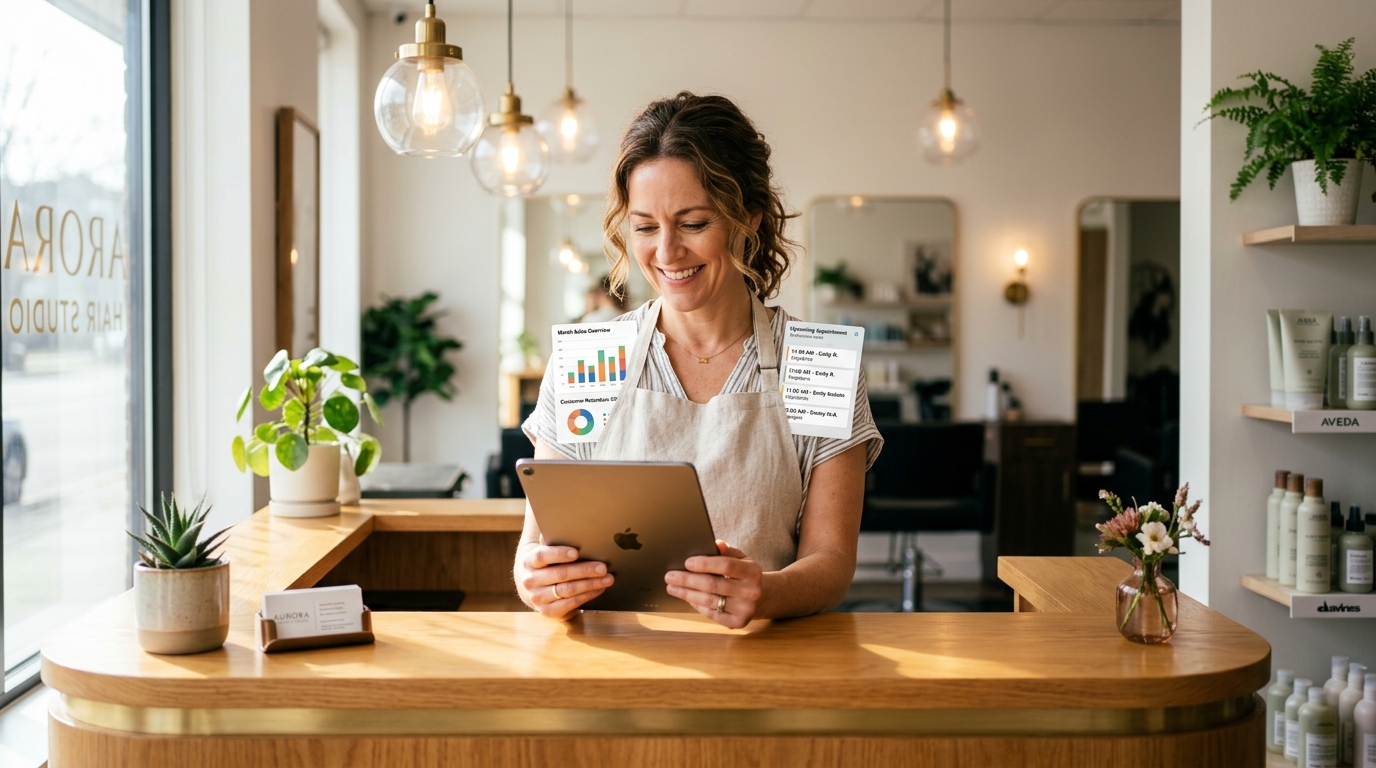
If you run a salon, AI schedules social media posts showcasing this week's styles. Booking reminders go out automatically. And review management software responds to every Google review, good or bad, within hours.
If you're in HVAC, an AI voice receptionist catches calls while your techs are on rooftops. Seasonal ad campaigns adjust automatically based on weather patterns. And follow-up emails keep past customers coming back for maintenance.
What we've seen: The businesses that get the most from AI marketing aren't the most technical ones. They're the ones that pick one problem, like missed calls or stale reviews, and let AI handle that one thing first. Results compound from there.
What AI Marketing Is NOT
Despite all the buzz, 82% of very small businesses still believe AI doesn't apply to them (AdAI, 2025). That belief is costing them customers. Most of the confusion comes from myths that sound reasonable but don't hold up.
"AI will replace me." It won't. AI handles tasks, not relationships. Your customers hire you because they trust you, not because you sent them a text message. AI sends the text. You deliver the work.
"It's too expensive for a small business." Most AI marketing tools cost $50 to $300 per month. You probably spend more on a Yellow Pages listing that nobody checks anymore. And 91% of small businesses using AI say their revenue went up (Salesforce SMB Trends, 2024).
"It's too complicated to set up." If you can post a photo on Facebook, you can set up an AI chatbot. These tools are designed for business owners, not engineers. Most take an hour or two to configure.
"It's just ChatGPT writing blog posts." That's one small piece. AI marketing covers chat, voice answering, review management, social media, Google optimization, ad targeting, and customer follow-up. Writing is maybe 10% of it.
"It's only for big companies." Actually, small businesses are adopting AI faster than anyone expected. 58% now use generative AI, up from just 23% two years ago (US Chamber of Commerce, 2025).
The real fear nobody talks about: Most local business owners aren't afraid AI won't work. They're afraid of spending money on something they don't understand and looking foolish. That fear is valid. But the solution isn't to avoid AI. It's to start with one simple tool you can see results from within a week.
5 Ways Local Businesses Use AI Marketing Today
Small businesses save 5 to 15 hours per week on marketing tasks by using AI tools (HubSpot, 2025). That's one to two full working days every week. Here are the five most popular ways local businesses are putting those hours back in their schedule.
1. AI Chat on Your Website
A chatbot greets visitors, answers common questions, and books appointments 24 hours a day, 7 days a week. When a potential customer hits your site at 10pm with a question, the chatbot handles it instead of letting that lead disappear. Typical cost: $50 to $150 per month.
2. Automated Review Requests
After every completed job, your customer gets a text with a direct link to leave a Google review. No manual follow-up needed. Businesses that automate review requests typically see their review count double within 90 days. And 76% of "near me" searchers visit a business within a day (Google/Backlinko). Reviews help you be the one they pick. Check out what your competitors' reviews are doing that yours aren't for a deeper look.
3. Google Maps Optimization
46% of all Google searches have local intent (Google/BrightLocal). AI tools monitor your Google Business Profile, suggest improvements, and keep your listing accurate across directories. That means showing up when someone searches "dentist near me" instead of being buried on page three.
4. Social Media Scheduling
AI generates post ideas based on your business type, writes the captions, and schedules them for the best times. You approve them with a tap on your phone. What used to take five hours a week now takes fifteen minutes.
5. AI Phone Answering
Never miss a call again, even when you're with a customer or driving to a job. An AI voice assistant picks up, answers basic questions, takes messages, and even books appointments. For a quick comparison of where to focus your marketing budget, see our guide on Google Ads vs. Google Maps for local businesses.
Is AI Marketing Right for Your Business?
91% of small businesses using AI report that their revenue increased (Salesforce SMB Trends, 2024). But AI marketing isn't a magic button. It works best for businesses where customers find you through search, calls, or your website.
Start with AI marketing if any of these sound familiar:
- You miss phone calls because you're busy with customers
- Your Google reviews haven't grown in three months
- Your website sits there doing nothing after 5pm
- You spend five or more hours a week on social media
- Competitors show up above you on Google Maps
You can probably wait if:
- You get all your business through word-of-mouth referrals
- You serve fewer than 10 customers a month
- You don't have a website or Google Business Profile yet (get those first)
The smartest approach? Pick one problem. Just one. Maybe it's missed calls. Maybe it's stale reviews. Maybe it's an invisible Google listing. Fix that first. See the results. Then decide if you want to expand.
83% of growing small businesses have already adopted AI, compared to only 55% of declining ones (Salesforce SMB Trends, 2024). The gap between those two groups is getting wider every quarter.
Want to see where your business stands online right now? Get a free SEO audit and find out exactly where AI marketing can make the biggest difference for you.
Frequently Asked Questions
How much does AI marketing cost for a small business?
Most local businesses spend $97-$500 per month on AI marketing tools. Individual tools like chatbots or review automation run $30-$150 per month each. Managed services, where an agency handles everything, typically cost $500-$2,000 per month. 91% of SMBs using AI report revenue increases that outweigh the cost (Salesforce, 2024). The mechanism behind the price range: standalone tools (a chatbot, a review request app) cost less because you're managing the configuration, the integrations, and the monthly tweaks; managed services cost more because someone else owns the outcome and adjusts as your business grows. According to a 2024 BrightLocal survey, the average local business now spends roughly $1,200/month across all digital marketing, so a single AI service usually replaces or augments existing spend rather than adding to it. The right next step: list every marketing tool you currently pay for and audit which ones a single AI service could consolidate.
Can AI replace my marketing person or agency?
AI handles the repetitive tasks like scheduling, responding, and optimising. It can't replace strategy, relationships, or local market knowledge. Think of AI as a very efficient assistant, not a full replacement. 77% of small businesses use AI to support their marketing efforts, not to eliminate their team (Salesforce, 2024). The mechanism is division of labour: AI is exceptional at high-volume, low-judgement work (drafting posts, sending review requests, qualifying chat leads, optimising bid strategy at scale) but is still poor at the high-judgement work that drives most marketing outcomes — choosing the right offer, framing it for the right audience, and adjusting strategy based on local context. The right next step: identify the three most repetitive tasks your marketing person currently does manually (the same five questions on chat, scheduling routine social posts, sending review requests one-by-one) and automate those before re-thinking headcount.
Is AI marketing safe for my business?
Yes, when you use reputable tools. Good AI marketing platforms follow data privacy standards (GDPR, CCPA) and don't share customer information with third parties. The bigger risk is actually not using AI at all — 83% of growing businesses have adopted it, while only 55% of declining ones have (Salesforce, 2024). The mechanism behind the safety/risk trade-off: established platforms have audited security practices, signed BAAs where required (healthcare), and store customer data in regulated regions, so the technical risk is comparable to using any other SaaS. The strategic risk of avoiding AI entirely is much larger because competitors who adopt earlier consolidate the local search visibility that's hardest to claw back later. The right next step: before signing up for any tool, check whether it has a published privacy policy, a data processing agreement, and SOC 2 compliance — those three signals filter out 90% of fly-by-night vendors.
How long before I see results from AI marketing?
Most local businesses see measurable improvements within 30-90 days. AI chat and phone answering show results immediately since you stop losing leads on day one. SEO improvements and review growth take 60-90 days to build momentum. 76% of people who search "near me" visit a business within one day (Google/Backlinko). The mechanism behind the variable timeline: chat and voice are demand-capture systems that work on traffic you're already getting, so the lift is instant; SEO and review channels are demand-generation systems that need Google to observe the new activity pattern over weeks before adjusting your visibility. According to Drift's 2024 conversational marketing report, chat-enabled sites convert visitors 4.6x faster than form-only sites, which is why AI chat consistently produces the fastest measurable wins. The right next step: deploy the demand-capture tool first (chat or AI voice) so you have positive ROI by week two while the slower channels compound.
Do I need to be tech-savvy to use AI marketing?
Not at all. Modern AI marketing tools are built for business owners, not developers. If you can post a photo on Facebook or send a text message, you can use these tools. Setup usually takes one to two hours with guided onboarding, and most tools run on autopilot after the initial configuration. The mechanism behind the low learning curve: the heavy lifting (training the model, updating algorithms, integrating with Google APIs, A/B testing variants) all happens inside the tool — your job is to provide the inputs (services, hours, FAQs, brand voice) and review the outputs (call transcripts, booked appointments, monthly summary report). According to a 2024 Salesforce SMB study, 56% of small business owners cite "lack of marketing time or skill" as their biggest growth blocker, which is exactly why this generation of tools is designed for non-technical operators. The right next step: pick a tool with phone or live-chat support during onboarding rather than a self-serve dashboard if technical setup intimidates you.
How much does AI marketing cost for a small business?
Most local businesses spend $97 to $500 per month on AI marketing tools. Individual tools like chatbots or review automation run $30 to $150 per month each. Managed services, where an agency handles everything, typically cost $500 to $2,000 per month. 91% of SMBs using AI report revenue increases that outweigh the cost (Salesforce, 2024).
Can AI replace my marketing person or agency?
AI handles the repetitive tasks like scheduling, responding, and optimizing. It can't replace strategy, relationships, or local market knowledge. Think of AI as a very efficient assistant, not a full replacement. 77% of small businesses use AI to support their marketing efforts, not to eliminate their team (Salesforce, 2024).
Is AI marketing safe for my business?
Yes, when you use reputable tools. Good AI marketing platforms follow data privacy standards and don't share customer information. The bigger risk is actually not using AI at all. 83% of growing businesses have adopted it, while only 55% of declining ones have (Salesforce, 2024).
How long before I see results from AI marketing?
Most local businesses see measurable improvements within 30 to 90 days. AI chat and phone answering show results immediately since you stop losing leads on day one. SEO improvements and review growth take 60 to 90 days to build momentum. 76% of people who search "near me" visit a business within one day (Google/Backlinko).
Do I need to be tech-savvy to use AI marketing?
Not at all. Modern AI marketing tools are built for business owners, not developers. If you can post a photo on Facebook or send a text message, you can use these tools. Setup usually takes one to two hours with guided onboarding, and most tools run on autopilot after the initial configuration.
The Bottom Line
AI marketing isn't about replacing you. It's about making sure your business shows up, answers, and follows up, even when you're busy doing the work your customers actually hired you for.
Here's what to remember:
- AI marketing means software that automates repetitive marketing tasks
- You're probably already using AI tools without realizing it
- Local businesses use AI for chat, reviews, Google Maps, social media, and phone answering
- Start with one problem, fix it, and expand from there
- Plans start under $100 per month, no enterprise budget needed
46% of all Google searches have local intent (Google/BrightLocal). Your next customer is searching for you right now. The only question is whether your marketing is running when they do.
SW Kruger is the founder of No Fingers AI, a marketing agency that helps local service businesses get more customers through AI-powered automation. He works exclusively with dentists, plumbers, salons, HVAC companies, and other service-based businesses.