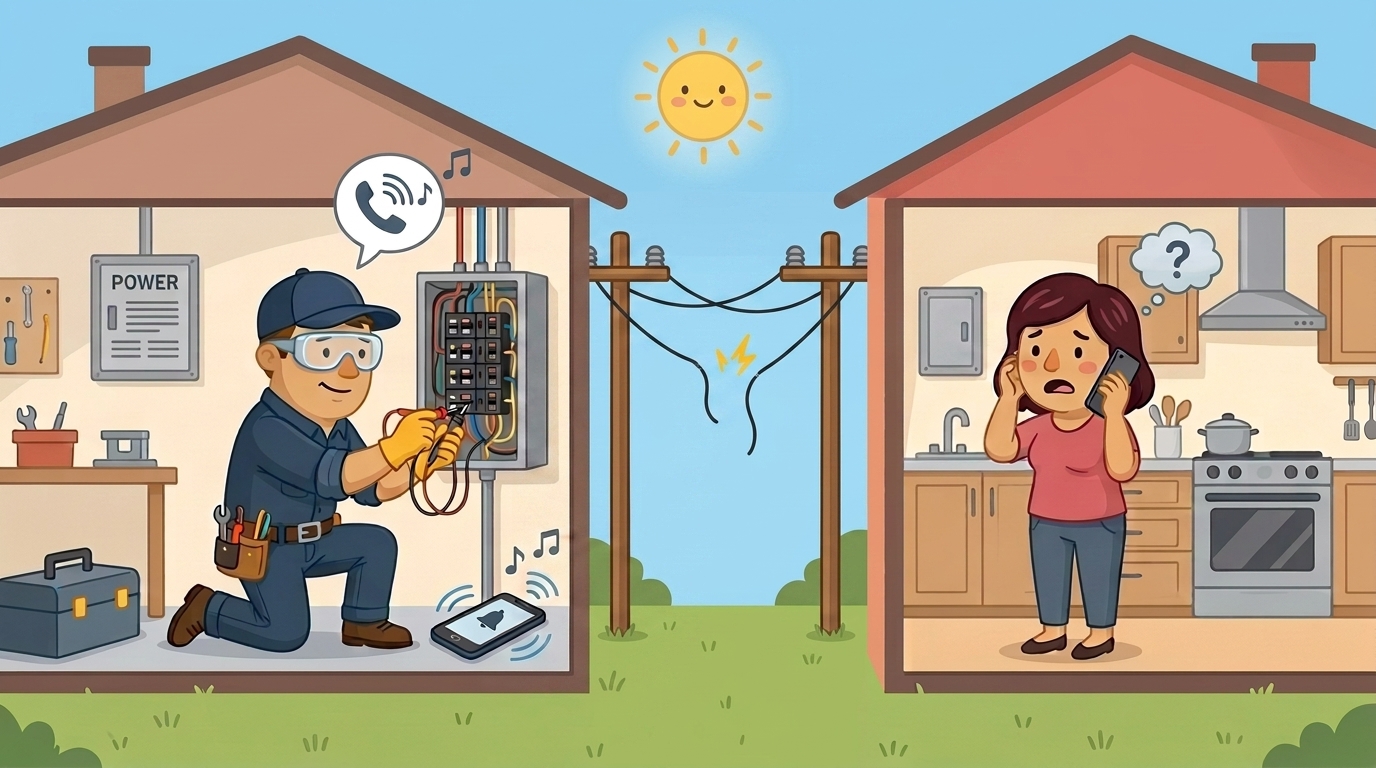
It's 6:14am on a Tuesday. A homeowner wakes up to find half the house dark — a breaker has tripped twice overnight and now won't reset. She grabs her phone and searches "emergency electrician near me." She taps the top result. Four rings, then voicemail. She doesn't leave a message. She taps the next listing. By 6:22am she's booked with someone else for an $1,800 panel diagnostic.
The electrician at the top of the search results sees the missed call at 8am, has no idea who it was, and never finds out. That one missed call was worth more than his entire monthly marketing budget. For most local service businesses, it isn't a one-off — it's the rule.
This guide covers what missed calls actually cost a local service business — not in the abstract, but in real dollars with the math worked out. Below: how many calls the industry misses, what each one is worth, the four reasons it keeps happening, and the five real fixes ranked from cheapest to most effective.
Key Takeaways
- 62% of small business calls go unanswered across 85 businesses studied in 58 industries (411 Locals, 2016); home services data shows 18% miss rate on weekdays and 41% on weekends (Invoca, 2024)
- The direct cost of a missed call averages $12.15 (Ambs Call Center, 2025); annualized losses range from $26K for a small operator to over $126K for high-ticket service businesses
- Companies that respond to a lead within 5 minutes are 100x more likely to connect and 21x more likely to qualify the lead than those who wait 30 minutes (Harvard Business Review, 2011)
- AI phone answering runs $199-$500/month — roughly 1/15th the cost of a full-time receptionist at $3,700-$5,000/month loaded (U.S. Bureau of Labor Statistics, 2024)
How Many Small Business Calls Actually Go Unanswered?
Across 85 small businesses in 58 industries, only 37.8% of inbound calls were answered live, 37.8% went to voicemail, and 24.3% got no response at all (411 Locals, 2016). The study is dated, but newer industry data tells the same story. Invoca's 2024 analysis of home services calls found an 18% miss rate on weekdays and a 41% miss rate on weekends.
The aggregate "62%" headline is real but blunt. The more useful number is what's happening in your specific industry, on your specific schedule:
If you run a home services business, the weekend gap is the part to look at hardest. 41% of weekend calls miss — and weekend calls are disproportionately emergencies, the highest-ticket jobs of the week.
What Does a Missed Call Actually Cost You?
The direct cost of a single missed call averages $12.15 when you account for staff time wasted on callbacks, voicemail processing, and basic admin (Ambs Call Center, 2025). That number alone is small. The number that matters is the revenue cost — what each unanswered call would have been worth if it had been answered live.
Here's the math, using Ambs' own framework. Multiply four numbers:
- Missed calls per month
- Your average customer or job value
- 12 months
- A conversion rate (industry standard is roughly 85% of qualified inbound calls)
For a solo plumber missing 10 calls a month with a $300 average ticket, the annual cost is roughly $30,600. For an HVAC company missing 30 calls a month with a $1,200 average ticket, the cost climbs to $367,200. For the dentist whose average new-patient lifetime value sits at $1,500, missing just 8 calls a month means walking past $122,400 a year in chair time.
This is where the widely-quoted "$126,000 a year in missed-call losses" figure comes from. It's not a single study. It's a calculation, and the answer depends almost entirely on your average ticket and how many calls you're letting drop.
The point isn't the headline number. The point is that almost no small business has actually done this calculation for themselves. Most owners I talk to are off by a factor of five — usually low. They think it's a $10K problem. It's a $50K-$300K problem.
Why Do Small Businesses Miss So Many Calls?
Small businesses miss calls for four boring, predictable reasons — and almost none of them are about laziness. The owner is usually under a sink, in someone's mouth, on a roof, or running payroll. The phone rings into a void that was never staffed to begin with.
The four causes, in order of frequency:
- No one is at the front desk. Most local service businesses under 10 employees don't have a dedicated receptionist. The phone forwards to the owner, who is doing the job. 60% of consumers click-to-call directly from Google search (Google/Ipsos, 2013) — and the bulk of those clicks come straight from your Google Maps listing or Google Ads, so the call hits the moment they decide they need you, usually when you're least able to pick up.
- After-hours and weekends. Most service-business inquiries hit between 5pm and 10pm on weekdays or any time on a Saturday. That's exactly when nobody is in the office. 41% of home services calls on weekends never get answered (Invoca, 2024).
- Voicemail kills the lead. Even when you do return the call, most people are gone. 67% of people don't listen to voicemails from business contacts, and only 18% listen to voicemails from unknown numbers (eVoice via CBS News, 2013). They've already called the next plumber on the list.
- Caller ID and spam suspicion. 92% of consumers now believe unidentified calls are fraudulent, and 46% of unknown calls go unanswered as a result (Hiya State of the Call, 2024). When you call a customer back from your cell at 8pm, they assume you're a scammer and ignore you.
The compound effect is brutal. A customer searches for "emergency plumber near me" at 9pm, taps your Google listing, hits voicemail, doesn't leave a message, and you call back at 7am the next morning from an unfamiliar cell number. They don't answer. You leave a voicemail. They don't listen to it. The lead is dead, and your $300 marketing-attributed Google click is dead with it.
This is also where speed matters more than anyone wants to admit. Firms that respond to a lead within 5 minutes are 100x more likely to make contact and 21x more likely to qualify the lead than firms that wait 30 minutes (Harvard Business Review, 2011). The lead doesn't just go cold. It evaporates.
What Are the Solutions, From Cheapest to Most Effective?
There are five real options for fixing missed calls, ranging from $0/month to roughly $5,000/month in total cost. Picking the right one depends on call volume, average ticket, and how much of your week you actually want to spend doing the work versus answering the phone.
Option 1: Voicemail with fast callback ($0/month)
Use what you have. Set a target of returning every voicemail within 5 minutes during business hours. This costs nothing but works only if you actually do it and only if customers leave messages. Most don't. Best for: extremely small operators (1-2 people) with low call volume.
Option 2: Call forwarding to mobile ($0-$20/month)
Set up your business line to forward to your cell phone after 2 rings, then to a second person's cell after 2 more. This works well if you have a partner or spouse who can pick up when you can't. Best for: family-run businesses with two-person coverage.
Option 3: Live answering service ($300-$1,500/month)
Real humans, usually based in a call center, answer your line 24/7 and take messages or follow a script you provide. They can book appointments if integrated with your calendar. Quality varies wildly. Best for: businesses that need a human voice but can't justify a full-time hire.
Option 4: AI phone receptionist ($199-$500/month)
A trained AI answers every call instantly, qualifies the caller, books the appointment directly into your calendar, and texts you a summary. Available 24/7. Pricing varies by provider and call volume (NextPhone, 2026; Smith.ai, 2026). Best for: most local service businesses with 50+ calls per month.
Option 5: Full-time human receptionist ($3,700-$5,000/month loaded)
Median receptionist wage is $17.90/hour, or about $37,272/year before benefits (U.S. Bureau of Labor Statistics, 2024). Add payroll taxes, benefits, equipment, and supervisor time, and the loaded cost lands between $3,700 and $5,000 per month. They cover ~40 hours per week, which means after-hours calls still go unanswered. Best for: established practices with high enough call volume to keep one person busy all day.
For most local service businesses doing $300K-$2M a year in revenue, the AI receptionist option lands in the sweet spot. It costs roughly 1/15th of a full-time hire, covers all 168 hours of the week, and handles the simple inbound flow — answering questions, qualifying the job, and dropping a booked appointment into your calendar. For a fuller cost picture of where AI fits next to traditional tools, see our AI vs. traditional marketing comparison.
How Does AI Phone Answering Work for a Small Business?
AI phone answering for a small business uses a trained voice agent that picks up the line, talks to the caller in natural language, asks the questions you'd ask, and writes the results into your calendar or CRM. The caller usually doesn't realize they're talking to AI. There's no menu tree. There's no "press 1 for service, press 2 for billing." It just feels like a polite, fast receptionist.
The basic flow:
- Customer calls your business number.
- AI answers on the first or second ring with your business name.
- AI asks what they're calling about, listens to the answer, and routes accordingly.
- For a service request: AI captures name, address, job type, urgency, and contact info.
- AI checks your live calendar and books the appointment in an open slot.
- You get a text message with the summary while the call is still happening.
- The customer gets a confirmation text with the appointment time.
The setup takes 1-2 hours for a typical local service business. You hand over a script (or let the AI build one from a conversation), connect it to your calendar, and forward your business line. From there, it's running.
The technology is the same kind that powers ChatGPT — generative AI — but tuned for voice and constrained to a specific job. For more on what AI marketing actually does for local businesses end-to-end, see our plain-English guide for local business owners.
The catch worth naming: AI is great at routine inbound. It's still bad at edge cases — angry customers, complicated diagnostic conversations, anything where empathy or judgement matters. The right setup escalates those calls to a human (you, or a backup line) instead of trying to handle them poorly.
What Results Do Businesses See After Fixing This?
Businesses that fix their missed-call problem typically see a 25-40% increase in booked appointments within 60-90 days, with no additional marketing spend. The reason is mechanical: the leads were already coming in. They just weren't getting captured.
Two recent examples worth naming:
- A luxury car rental company in Atlanta deployed AI voice answering across two locations and handled 1,017 calls in four months, qualifying 778 leads at a 76% conversion rate (Vendasta, 2025).
- Apex Roofing reported a 40% increase in booked estimates after rolling out an AI receptionist across their sales line (Zenplus, 2025).
The pattern is consistent across industries. When a business that was missing 30-50% of inbound calls drops that number to under 5%, their booked-job rate goes up sharply within a single quarter. The marketing budget stays the same. Only the catch rate changes.
Adoption is moving fast for a reason. 98% of small businesses now use at least one AI-enabled tool (U.S. Chamber of Commerce, 2024), and Salesforce projects that AI will handle 50% of customer service interactions by 2027, up from 30% today (Salesforce State of Service, 2025). The local service businesses that are getting ahead of this are picking up customers the slower-moving competitors are dropping.
Frequently Asked Questions
How many calls does the average small business miss per month?
It varies by industry, but home services businesses miss roughly 18% of weekday calls and 41% of weekend calls (Invoca, 2024). A solo plumber taking 40 calls a week will typically miss 8-15 of them. A dental practice with 100-150 weekly inquiries will typically miss 20-40.
Is AI phone answering reliable enough to replace voicemail?
For routine inbound — booking appointments, answering basic questions, qualifying leads — yes. 89% of service professionals report that conversational AI increases self-service resolution rates (Salesforce, 2025). For complex calls (angry customers, complicated diagnostics, sensitive conversations) the right setup escalates to a human.
How much does an AI receptionist actually cost?
AI receptionist pricing runs $199-$500/month for most local service businesses, with budget options starting around $29-$79/month and premium services reaching $800+/month (NextPhone, 2026; Smith.ai, 2026). Cost is usually based on call minutes per month, not a flat fee.
How is AI cheaper than a human receptionist?
A median U.S. receptionist earns $17.90/hour, or $37,272/year, which loads to $3,700-$5,000/month after benefits (U.S. Bureau of Labor Statistics, 2024). An AI receptionist costs $199-$500/month and covers 168 hours a week instead of 40. The math isn't close.
What if a customer asks something the AI doesn't know?
Good AI receptionists are configured to either escalate to a human or schedule a callback when they hit a question outside their script. The bad ones loop or hallucinate. Avoid the bad ones — test the system yourself before deploying it on your business line.
Does AI phone answering work for emergency-service businesses?
Yes, and these are often the highest-ROI use case. Emergency calls (HVAC failures, plumbing leaks, electrical outages) come in disproportionately after hours, which is exactly when no other option covers the phone. The 6:14am water heater call gets captured instead of lost.
The Bottom Line
62% of small business calls go unanswered. The direct cost of each one is small. The revenue cost is enormous, and most owners have never calculated it.
Here's what to remember:
- The cheapest fix is a 5-minute voicemail callback discipline — but it only works during business hours
- The cheapest 24/7 fix is an AI receptionist at $199-$500/month
- A human receptionist costs 10-15x more and still doesn't cover nights or weekends
- The 5-minute speed-to-lead rule means a fast pickup is worth more than a smart callback
- Most local service businesses doing $300K-$2M see their booked-job rate rise 25-40% within 90 days of fixing this
You probably don't know how many calls your business is missing. Most owners are off by a factor of five — usually low. Want a free audit that tells you exactly how many calls are slipping past you each month and what they're costing you? Get yours here.
SW Kruger is the founder of No Fingers AI, a marketing agency that helps local service businesses get more customers through AI-powered automation. He works exclusively with dentists, plumbers, salons, HVAC companies, and other service-based businesses.